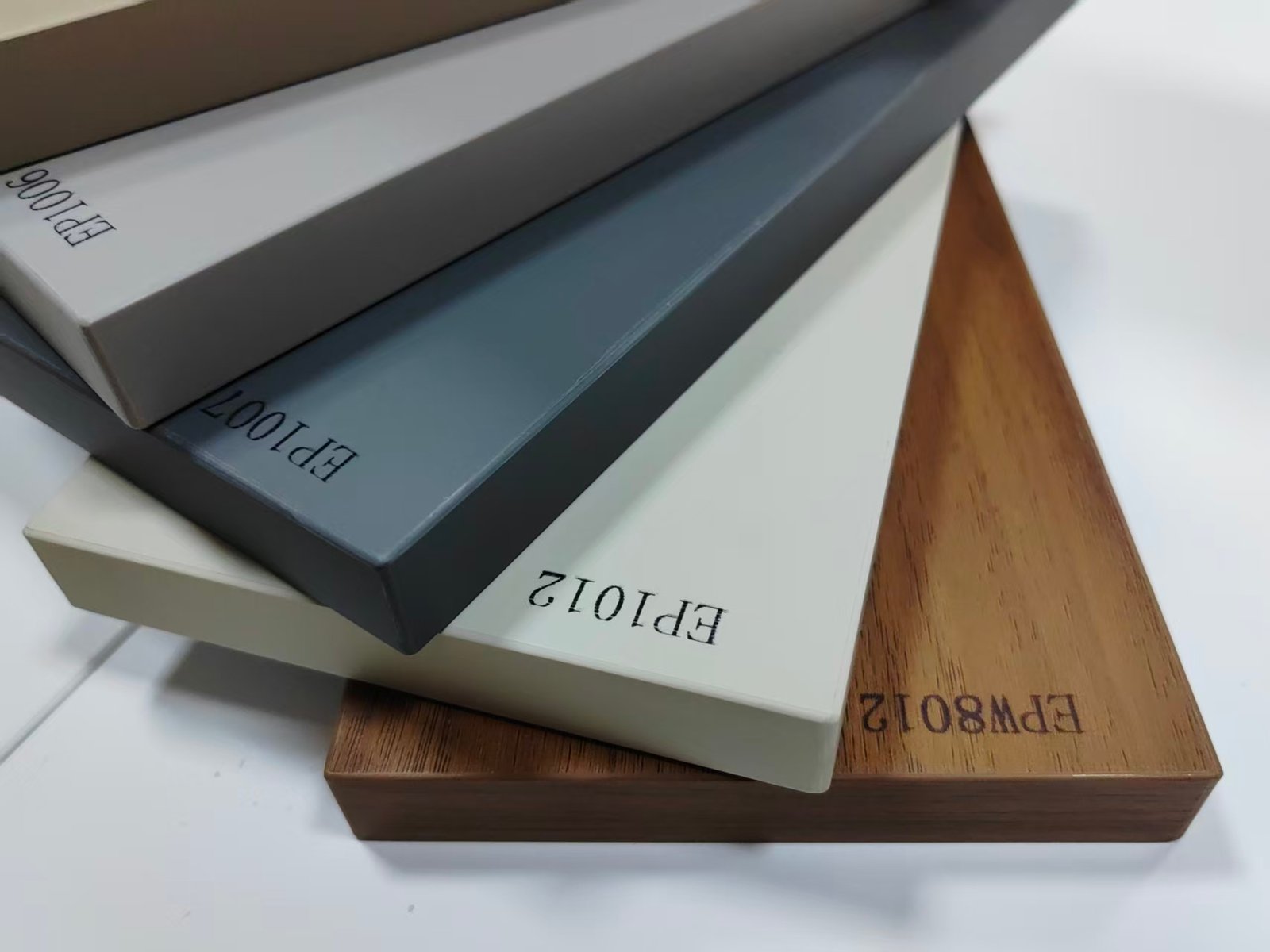
Cabinet makers and contractors often ask us the same question: The edge of an aluminum honeycomb panel has opened. Why?
At first glance, it looks like a single fault with a single cause. Most people assume the adhesive failed, or that the panel was manufactured incorrectly. After examining panels returned from different projects, we found that an opened edge rarely comes from one place.
Sometimes the PVC edge banding has separated from the panel face. Sometimes the aluminum skin has come away from the honeycomb core. In other cases the edge was damaged during CNC machining, transport, or installation while the panel itself stayed sound.
That is why an opened edge should be treated as a symptom, not a diagnosis. The first question is not what went wrong. It is where the failure actually happened. Once the layer is known, the cause narrows quickly, and so does the decision in front of you: accept the panel, rework it before installation, or replace it.
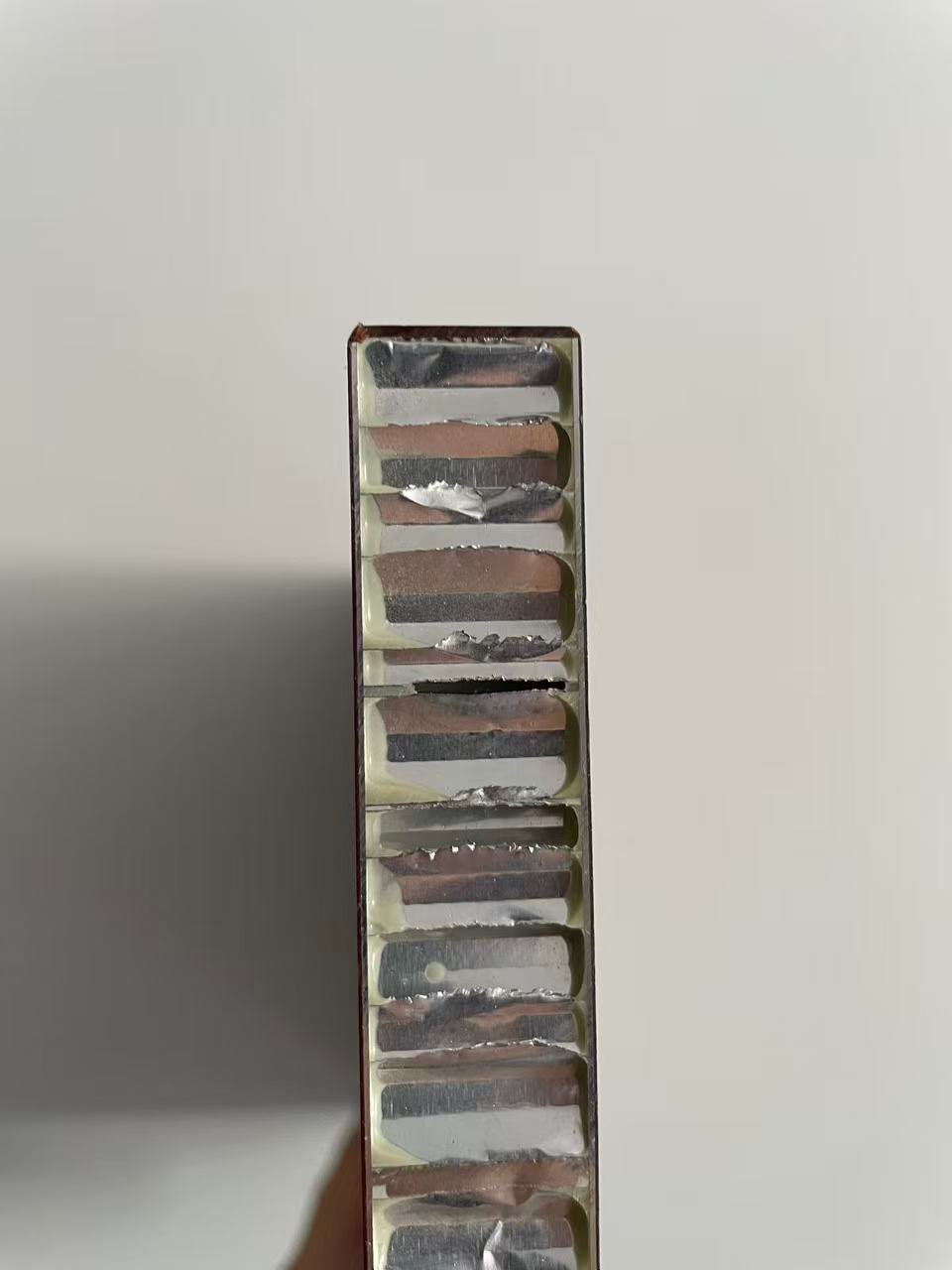
What Sits Inside an 18 mm Aluminum Honeycomb Panel Edge
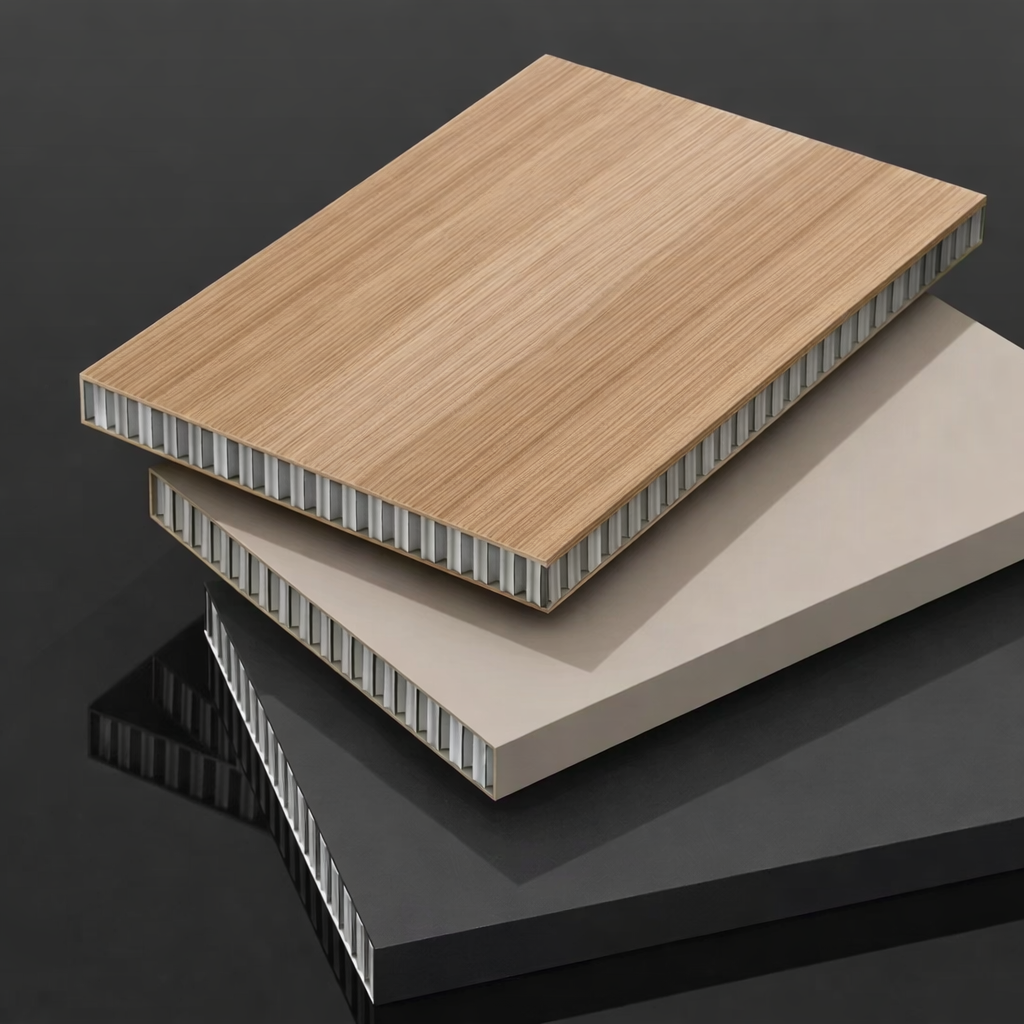
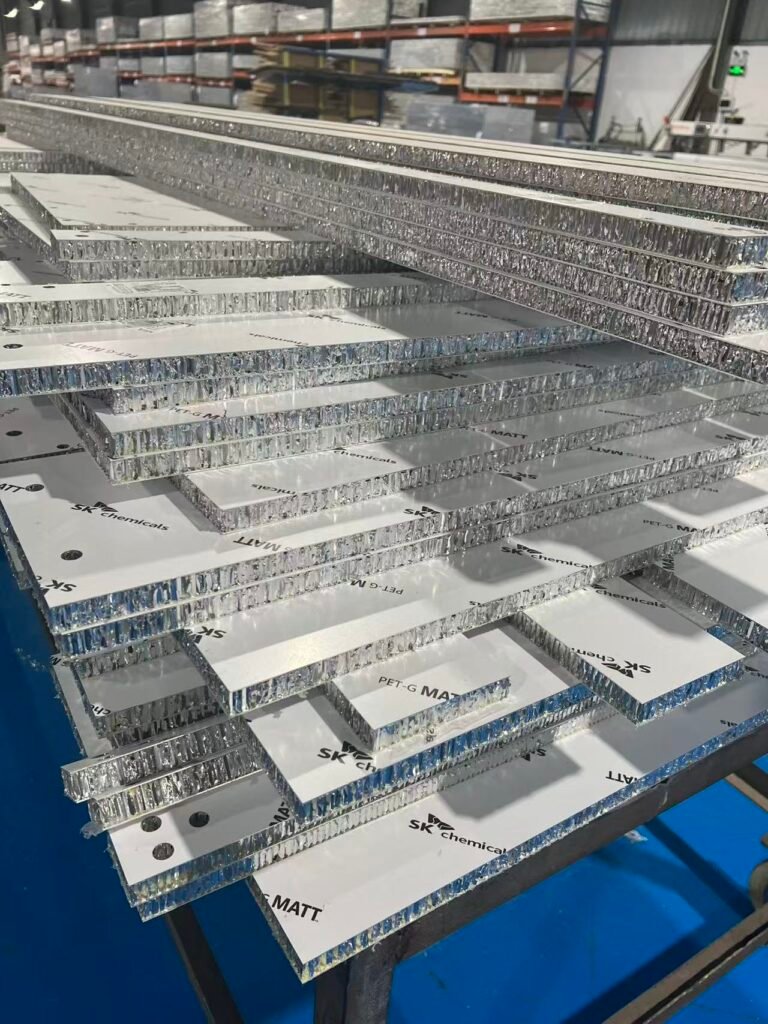
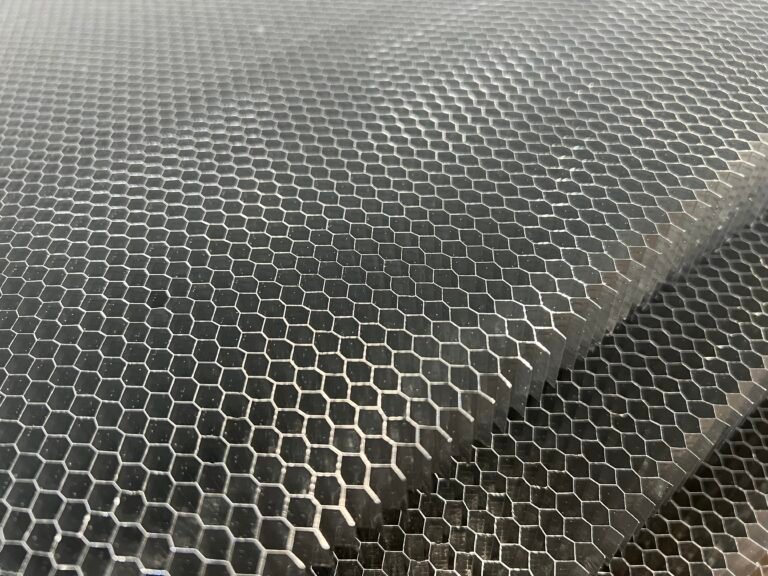
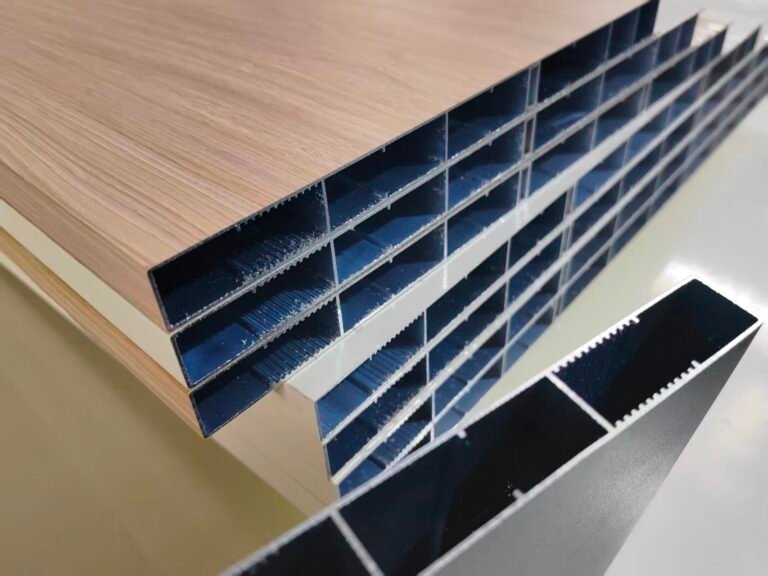
To judge an edge you first have to know what the edge is made of. Our cabinet panels are built on an 18 mm aluminum honeycomb board. The face is aluminum skin in 0.65, 0.75, 0.8, 0.85, or 1.0 mm, and the core is an aluminum honeycomb with 2 × 2 mm or 3 × 3 mm cells. We supply 2 × 2 mm for most cabinet work, because the denser core takes adhesive better.
Between the two skins the panel is not solid. It is a grid of open cells, and that is the fact that decides how the edge should be judged.
Closing the rim takes two different adhesives. The skin is bonded to the core with a two-component polyester adhesive that cures by chemical reaction rather than by cooling. The PVC edge banding that closes the panel is applied with PUR hot melt, a reactive polyurethane that crosslinks as it sets. That crosslinked bond is what lets PUR hold up to moisture and heat better than a standard EVA hot melt.
The two joints fail for different reasons, and they are repaired in different ways. A panel whose edge band has lifted is not the same problem as a panel whose skin has come off the core, even when the two look alike from arm’s length.
Straight panels and regular shapes are edge-sealed on the standard line. Any outline that is not a regular shape, such as a curved or recessed profile, goes through shaped edge treatment instead. Curved and recessed edges belong on the list of places worth inspecting most closely.
Find the Failure Layer Before You Name the Cause
An opened edge looks identical from two metres away and completely different from 200 mm. Locate the layer that gave way first, because each layer points at a different cause and a different remedy.
| What you see at the edge | Which joint failed | What usually causes it |
|---|---|---|
| The band has lifted, curled, or come away from the panel face | The bond between the PVC edge banding and the aluminum skin | The edge sealing step, or the band was disturbed after it had cured |
| The skin has come away from the core and cells are open underneath | The two-component bond between skin and honeycomb core | Panel bonding, or heat and moisture reaching the bond line over time |
| The rim is chipped, crushed, or torn, and cells are open to the outside | Neither joint. The panel edge itself was damaged | CNC parameters, cutting pressure, transport, or handling on site |
Two of these are bond failures. The third is not a bond failure at all. That is why changing the adhesive never repairs a machined edge, and why a panel damaged in transit tells you nothing about how it was bonded.
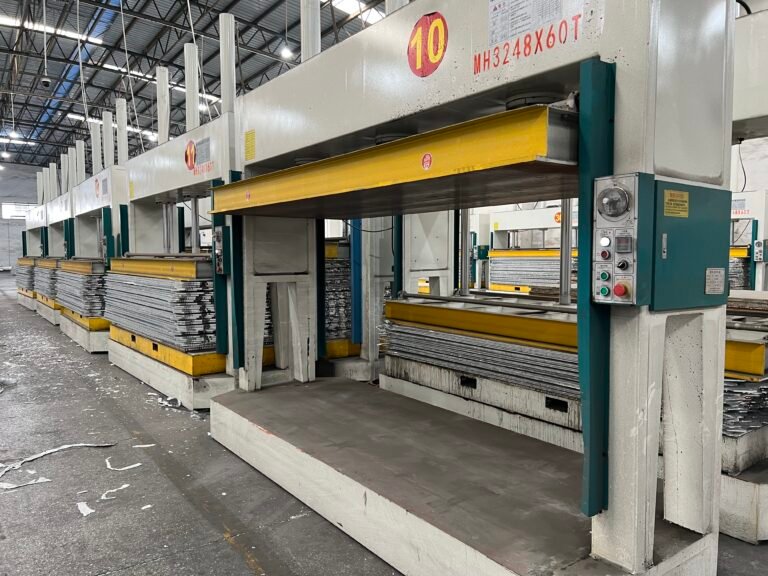
During production we inspect the edge after CNC machining, again after edge sealing, and once more before packing, because an edge defect is far cheaper to catch in the factory than on site. The full sequence is described in How We Manufacture Custom Cabinet Panels: From CAD Design to Safe Delivery.
Does an Opened Edge Mean Moisture Will Get In?
Moisture resistance is the first reason customers give us for switching from MDF or plywood to an aluminum honeycomb panel, ahead of pest resistance, service life, and dimensional stability. An opened edge is exactly where that advantage is lost, because the core between the two skins is an open channel. Once the closure at the rim is broken, the channel is open to the air.
How far water actually travels depends on how long the opening runs and where the panel is installed. What we can state is what the edge itself is built with. Our panels use PUR hot melt on the edge banding rather than a standard EVA hot melt. PUR crosslinks as it sets, so the standard edge already stands up to the humidity of a working kitchen.
For a project in a permanently wet room, the edge adhesive can be taken further. On request we apply a higher grade than the standard PUR, because a bathroom or a commercial food area is wet every day rather than occasionally. The acceptance test at delivery does not change either way, and the reasons aluminum panels suit kitchen cabinets at all are covered in why aluminum honeycomb panels are a smart choice for kitchen cabinets.
Edge Acceptance: Wrap Integrity, Not Gap Width
Most edge-banded boards are inspected by measuring how wide a gap has opened, because on a solid board a small gap is a small problem. A honeycomb panel does not work that way. The core is hollow, so the moment a cell is exposed the panel is no longer sealed at that point. There is no such thing as an acceptably narrow opening into an open channel.
That changes what the acceptance test is. For our panels it is not a measurement. It is a question of whether every cell is closed. A panel passes when the rim is fully wrapped, and it fails when any cell is left open, on a visible edge or a hidden one, at any point along the perimeter.
| What to check | Accept | Reject |
|---|---|---|
| Edge banding along the whole perimeter | Band tight against the face, no lift and no curl anywhere | Any lift, curl, or released section, including a short one at a corner |
| Honeycomb at the rim | Every cell closed by the band or by filler, none visible | Any cell open or visible, on any edge, hidden edges included |
| Edge face after machining | Flat and clean, the band sitting flush against a sound rim | Crushed cells, chip-out, or a rim cut back so far that the band cannot cover it |
| A cut section of the edge | Continuous bond line, no voids between skin and core | Voids, or adhesive sitting only on the surface |
These four checks sort a delivery into three outcomes. A panel that passes all four is accepted as delivered. A panel whose band has lifted in one place, while the face, the rim, and the core underneath are all intact, can be reworked before installation by cleaning out the old adhesive and pressing the band again. A panel with an open cell, a separated skin, or a machined rim cannot be reliably repaired and should be replaced.
If you are buying honeycomb panels rather than making them, the one question worth adding to your supplier audit is what the edge banding is bonded with. A band applied with standard EVA hot melt can look perfect on delivery and still release in a humid kitchen. On a wet-area project, put the adhesive grade in the specification instead of leaving it to the supplier’s default.
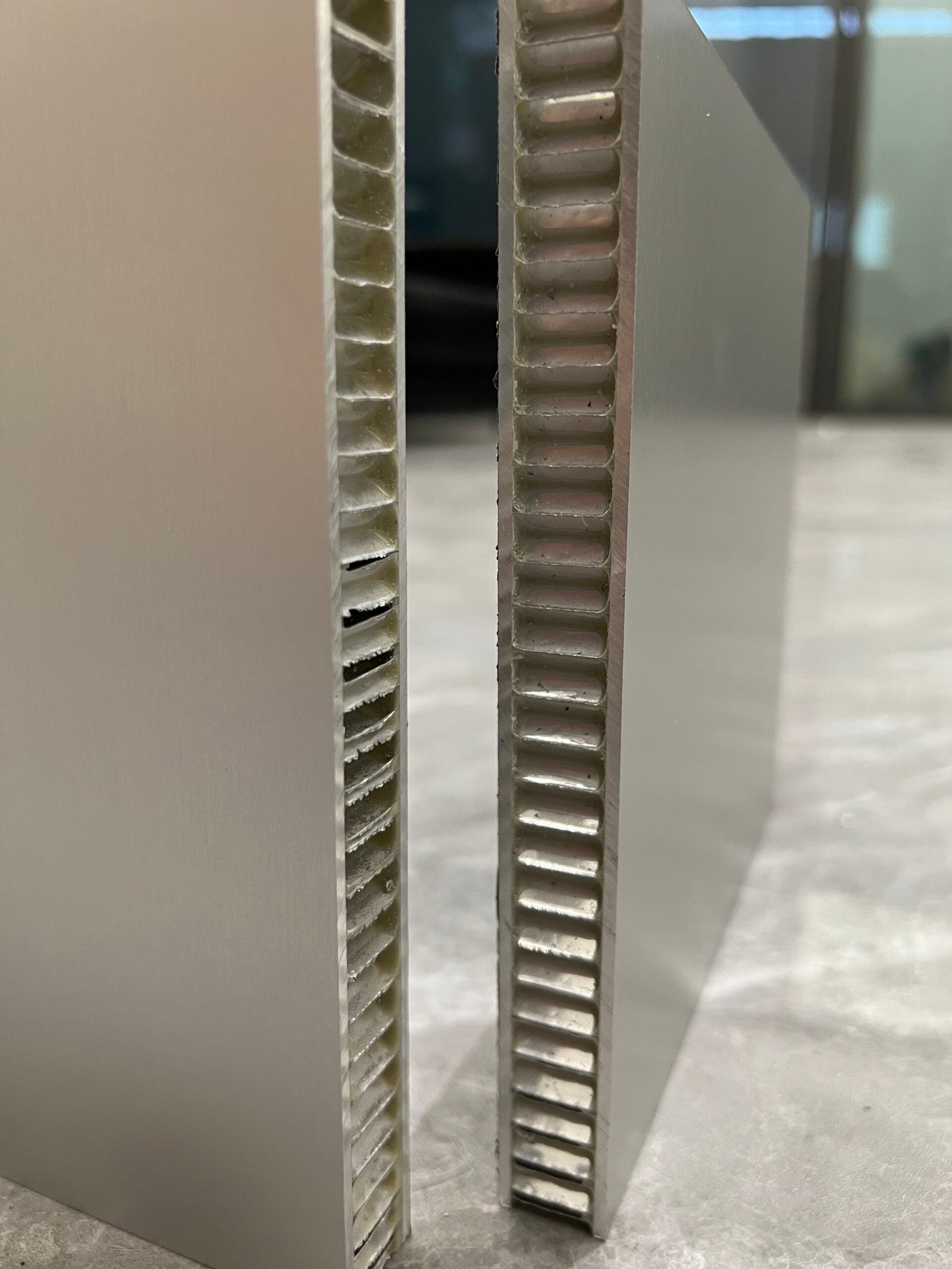
What to Photograph Before You Call Us
When a customer sends a message that says only “the edge is open”, there is not enough information to name a cause. Three photographs settle most cases.
The first is a picture of the whole edge from about a metre away, which shows whether the band has released along its length or only at one point. The second is a close-up from around 200 mm, which shows whether the aluminum skin is still bonded to the core or whether cells are open underneath it. The third is a cut section if you can take one, because a section is the only view that shows whether the bond line is continuous or full of voids.
Along with those, tell us the panel construction you ordered and where the panel is installed. With those pieces we can usually say whether the problem sits in the edge sealing, the panel bonding, the machining, or the handling, and what the next step should be.