
How to Evaluate an Aluminum Honeycomb Cabinet Manufacturer: A 7-Step Checklist
Introduction
When sourcing aluminum honeycomb cabinets, buyers usually lead with price and appearance. Those don’t tell you if a supplier can deliver consistently, so judge the production workflow instead.
1. Drawing Validation & Material Nesting
What it is: Engineering review confirms drawings are buildable before cutting; nesting software then optimizes layout and barcodes each panel for traceability.
| What to Ask | Good Answer | Red Flag |
| “Show me your drawing review checklist” | Written checklist covering dimensions, holes, hardware, assembly, install sequence | “We just check the dimensions” |
| “How do you handle drawing discrepancies?” | Formal RFI/RFQ process with sign-off before cutting | “We’ll figure it out on the line” |
| “Can you show a nesting layout from a recent project?” | Optimized layout, utilization >85% | No record, or wasteful layout |
| “How do you trace a panel to its source?” | Barcode/QR linking panel to drawing + batch | “We know the batch” (no proof) |
2. CNC Cutting & Front-Side Pre-Drilling
What it is: CNC cuts panels and drills front holes (handles, hinges). Drill front holes before cutting the panel free, while the sheet is still intact, to minimize offset.
| What to Ask | Good Answer | Red Flag |
| “Drill front holes before or after cutting free?” | Before — on the intact sheet | “After cutting” / “Doesn’t matter” |
| “Your hole position tolerance?” | ±0.3 mm or better | ±1.0 mm / “It’s fine” |
| “Photo of CNC output with caliper measurement?” | Shares; matches spec | Refuses / no photos |
| “Typical material utilization rate?” | 80–90% | Below 70% |
3. Edge Banding & Sealing Treatment
What it is: Edges are sealed with edge-banding and adhesive after cutting, non-negotiable for moisture resistance. Standard process: inject adhesive into the core, press banding, trim flush, polish.
| What to Ask | Good Answer | Red Flag |
| “Edge-band adhesive for wet areas?” | PU or waterproof (brand specified) | “Standard glue” / won’t say |
| “Edge banding on curved panels?” | Profile edge-banding machine / jig | “We avoid curves” / hand-only |
| “Cross-section sample of your edge seal?” | Core fully filled, no voids | Voids, surface-only adhesive |
| “Edge peel strength spec?” | Cites a value or test | “It sticks fine” |
4. Precision Side-Hole Drilling
What it is: Side holes for cam locks and dowels decide whether joints align or need rework. Use dedicated side-hole machines with infrared positioning; handheld drills can’t hold consistency at volume.
| What to Ask | Good Answer | Red Flag |
| “Equipment for side-hole drilling?” | Dedicated machine with IR positioning | Handheld / manual jig |
| “How do you verify hole accuracy?” | Caliper per panel / vision system | Visual only |
| “Side-hole position tolerance?” | ±0.5 mm or better | “Close enough” / no spec |
| “Field issues from misaligned holes?” | Honest answer with fix | “Never” (suspicious) |
5. Hardware Insertion & Pre-Installation
What it is: Inserts go into pre-drilled holes before shipping. Cam-lock 3-in-1 connectors are standard and expose any machining error.
| What to Ask | Good Answer | Red Flag |
| “Hardware pre-installed before shipping?” | Yes, all nuts and bolts fitted | “You install on-site” |
| “Hardware brand? Can I specify?” | Named brand (Hettich, Blum, Hafele) or your spec | Unknown / refuses |
| “Prevent reversed or missing inserts?” | Photo check per panel | “Workers are experienced” |
| “Spare hardware per package?” | 2–5% extra, standard | No spares |
6. Full Pre-Assembly Inspection
What it is: Full assembly under real install steps, a dry-run before shipment. Pre-assembling every order catches issues internally; skipping it ships blind.
| What to Ask | Good Answer | Red Flag |
| “Pre-assemble before shipping?” | Yes, 100% of orders | “Sample only” / No |
| “Photos or video of recent pre-assembly?” | Shares, systematic | No records |
| “Pre-assembly pass rate and failures?” | Knows number; rework protocol | “They pass” / no tracking |
| “Who signs off pre-assembly QC?” | Dedicated QC with log | Line worker self-check |
7. Multi-Layer Protective Packaging
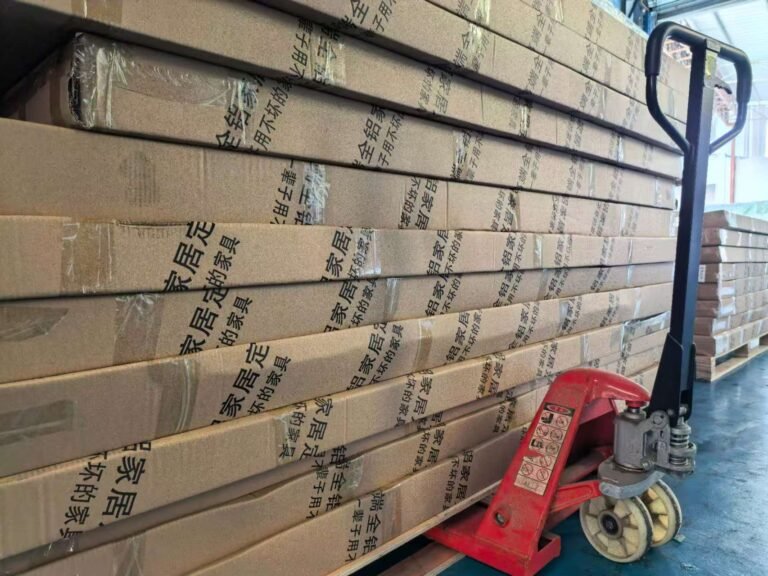
What it is: Even perfect cabinets get damaged in transit without proper packaging, especially on ocean freight.
| Layer | Purpose |
| 1. Honeycomb cardboard wrap | Cushions scratches |
| 2. Flat cardboard | Surface protection, rigidity |
| 3. Rigid corner protectors | Edge/corner impact |
| 4. Stretch film | Secures layers, moisture barrier |
| 5. Pallet stacking | Stable forklift base |
| 6. Desiccant (if needed) | Moisture control at sea |
| 7. Marking / labeling | Handling, PO, panel IDs |
| What to Ask | Good Answer | Red Flag |
| “Packaging layers for ocean freight?” | 4+ systematic layers | “Film and pallet” only |
| “Transit damage claims?” | Honest % and resolution | “Never happens” |
| “Photo of packed pallet?” | Shares immediately | Hesitates |
| “Desiccants for humid shipments?” | Yes, standard | No / “Not needed” |