How Does Honeycomb Core Cell Size Affect Cabinet Door and Furniture Panel Performance?
When choosing aluminum honeycomb panels for cabinet doors or furniture panels, buyers often focus on the surface finish, panel thickness, or aluminum skin thickness. But there is another specification that is often overlooked yet can have a real impact on the finished product: honeycomb core cell size.
However, not every aspect of panel performance is determined by cell size. Its role has clear boundaries. Cell size mainly affects local support rather than overall bending stiffness. It can help improve surface flatness and edge support, but it does not prevent a cabinet door from sagging.
Understanding this distinction can help manufacturers, designers, and buyers choose the right honeycomb core for their application.
- Understanding the Structure: Where Does Panel Stiffness Come From?
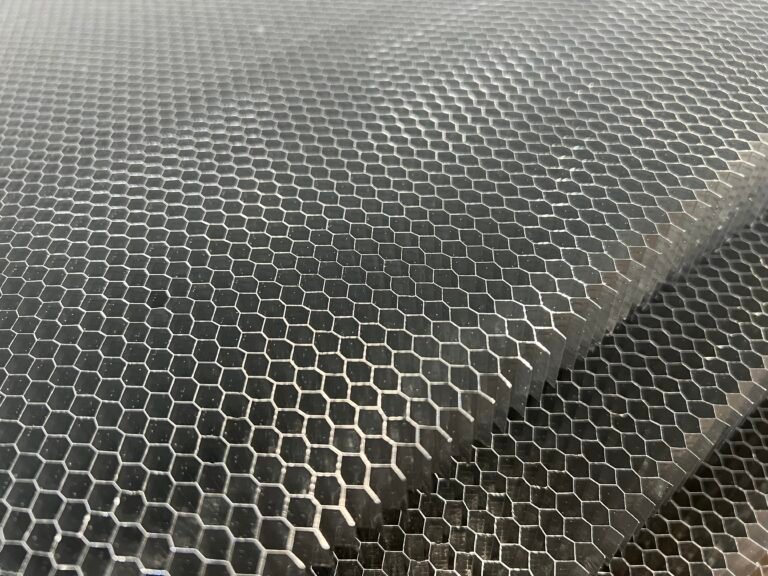
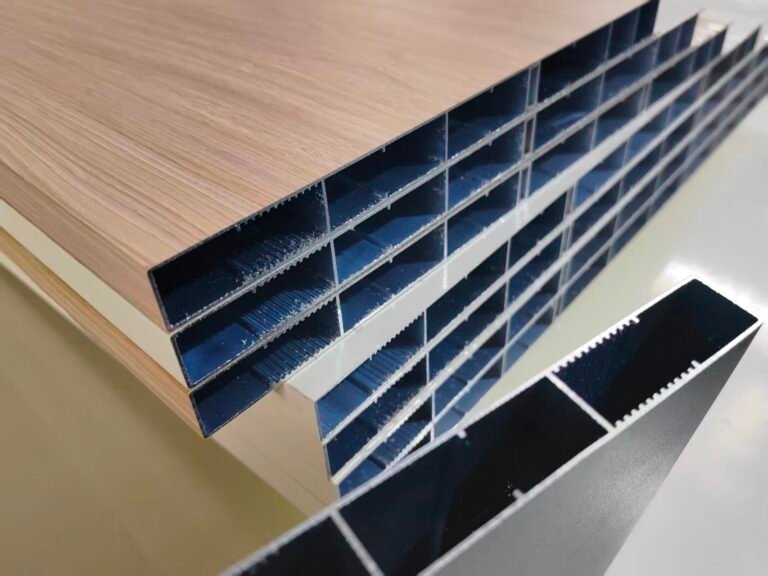
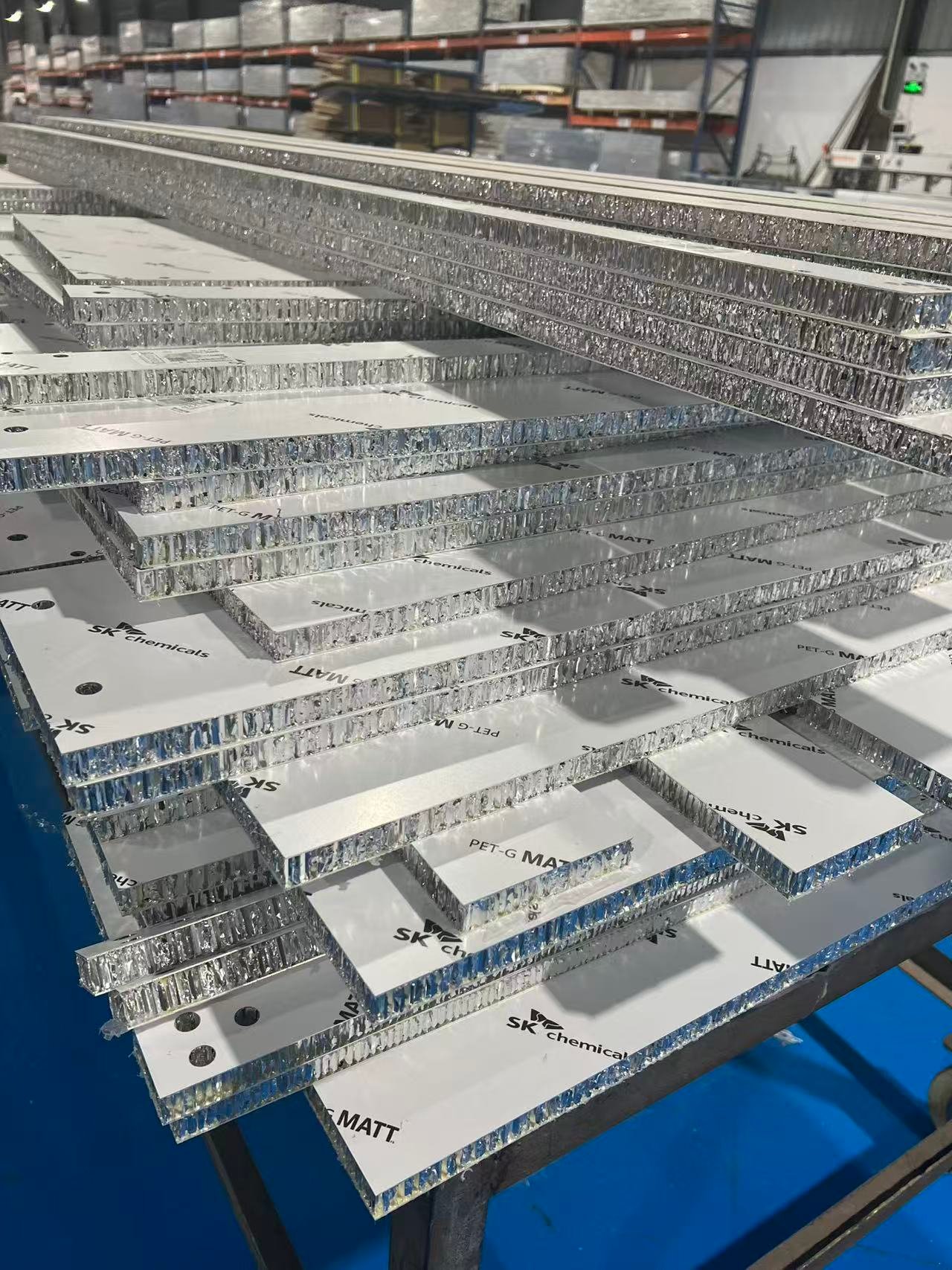
An aluminum honeycomb panel is a typical sandwich structure, consisting of two aluminum face sheets and a honeycomb core between them.
A common misconception is that the smaller the honeycomb cells, the stiffer the entire panel. This is not quite accurate.
The overall bending stiffness of a sandwich panel is mainly related to the thickness and modulus of the aluminum face sheets, the square of the core thickness, and the shear properties of the core. In simple terms, the core thickness that separates the two face sheets plays a much more important role in overall bending stiffness than cell size alone.
So what does cell size actually control?
It mainly affects local support.
A smaller cell size means more cells within the same area. This creates more closely spaced support points for the aluminum face sheets. As a result, the face sheets are less likely to experience local instability, wrinkling, or indentation under localized pressure.
A more accurate way to describe the relationship is that smaller cells provide denser and more uniform local support. They should not be treated as a direct substitute for greater overall panel thickness or core thickness.
- What Can a Smaller Cell Size Actually Improve?
Better Surface Flatness
Large cabinet doors, especially tall slab doors and full-height flat panels, are highly sensitive to local surface irregularities.
A denser honeycomb core provides more evenly distributed support behind the aluminum face sheet. This can help reduce unsupported areas and contribute to a more consistent surface.
For large, flat cabinet doors where appearance is important, this can be a meaningful advantage.
Better Resistance to Localized Pressure
Cabinet doors and furniture panels can experience localized pressure during transportation, installation, and everyday use.
With a smaller cell structure, more support points are available beneath the face sheet. Localized pressure can therefore be distributed across a denser internal structure.
This can improve the panel’s resistance to local indentation or denting, particularly when the aluminum face sheet itself is relatively thin.
Better Support for the Aluminum Face Sheet
The aluminum face sheet is the visible surface of the panel, but its behavior also depends on how well it is supported from behind.
When the honeycomb cells are larger, the unsupported span between individual cell walls is also larger. With thinner aluminum skins, this can make the face sheet more sensitive to local deformation or surface waviness.
A smaller cell structure provides more closely spaced support and can therefore help the face sheet maintain a more stable surface.
More Reliable Edge Support and Bonding
Another factor that is particularly important for cabinet panels is the edge.
Cabinet doors and furniture panels often require aluminum edge profiles, U-channels, edge strips, or other edge-finishing solutions.
A smaller cell size creates a denser structure near the panel edge, providing more closely spaced supporting points. This can create a more favorable structural base for edge bonding and help improve the stability of the finished edge construction.
However, cell size is only one part of the bonding system. Final bonding performance also depends on the adhesive system, surface preparation, edge profile, aluminum skin, bonding process, and manufacturing quality.
- What Does a Smaller Cell Size Not Solve?
This is an important boundary that should not be overlooked.
If a cabinet door becomes saggy after installation, does not close properly, or develops an uneven gap, changing to a smaller honeycomb cell size is not a direct solution.
Door sagging is usually related to factors on the hinge side, including:
- Door weight and the resulting torque
- Hinge load capacity
- Screw holding strength
- Hinge and mounting hardware
- Installation accuracy
- Incorrect hole positions
- Cabinet squareness
- Cabinet or floor support conditions
In other words, a denser honeycomb core does not automatically prevent a cabinet door from sagging.
Cell size is primarily a factor in local support, surface consistency, and panel construction, not a solution for hinge-side door sagging.
This distinction is important for manufacturers because selecting a smaller cell size should not be used as a substitute for choosing the correct hardware and installation method.
- Why Are Larger Honeycomb Cells Still Used?
If smaller cells can provide denser support, why are larger cells still common in the market?
The answer is simple: material efficiency and application requirements.
A larger cell structure uses fewer cells within the same panel area. This can reduce core material consumption and help control material cost.
For panels with moderate dimensions and less demanding performance requirements, a larger cell size may be a reasonable and practical choice.
The issue is not that large cells are inherently unsuitable.
The real question is whether the cell size is appropriate for the panel dimensions, surface requirements, and intended application.
As cabinet doors become wider, taller, and flatter, the need for consistent internal support becomes more important.
- Where Is the Risk of a Larger Cell Size?
As cell size increases, the distance between individual support points also increases.
For a relatively small panel with moderate requirements, this may not create a noticeable problem.
But as panel dimensions increase or surface flatness becomes more critical, a more open honeycomb structure can provide less uniform local support to the aluminum face sheet.
This may increase sensitivity to:
- Localized pressure
- Surface irregularities
- Face-sheet deformation
- Edge support requirements
This does not mean that a large-cell honeycomb panel will necessarily fail. The risk depends on the complete panel construction and application.
The larger the panel and the higher the surface-performance requirements, the more carefully cell size should be evaluated.
- How Should Buyers Choose the Right Cell Size?
When comparing honeycomb core options, do not start by asking only whether you should choose 2×2 or 3×3.
First look at the complete application.
Panel Size
The larger and taller the cabinet door, the more important consistent local support becomes.
For demanding large panels, a denser core can be considered together with an appropriate aluminum skin thickness and core thickness.
Surface Flatness Requirements
If the project involves high-visibility surfaces, large slab doors, or full-height flat panels, surface consistency may be a higher priority.
In these applications, the advantages of a denser cell structure can become more relevant.
Application and Local Loads
Consider whether the panel is likely to experience localized pressure during production, transportation, installation, or daily use.
Also consider whether the panel requires edge profiles or other edge-bonding solutions.
The Complete Panel Construction
The final performance of a honeycomb panel is not determined by cell size alone.
A more useful way to evaluate the panel is:
Panel Size + Aluminum Skin Thickness + Core Thickness + Adhesive System + Edge Construction + Hardware + Application
Cell size is one important variable within this system, not the entire answer.
- 2×2 vs. 3×3 Aluminum Honeycomb Core
Our company offers 2×2 and 3×3 aluminum honeycomb core options for cabinet and furniture panel applications.
Both are relatively fine-cell options designed for applications where consistent internal support is important.
The key difference is the cell structure.
2×2 Aluminum Honeycomb Core
With a smaller cell size and denser structure, 2×2 is a suitable choice when local support and surface performance are higher priorities.
It can be considered for:
- Large cabinet doors
- Tall or wide slab doors
- Applications with high surface-flatness requirements
- Panels requiring better resistance to localized pressure
- Applications where edge support is particularly important
3×3 Aluminum Honeycomb Core
3×3 uses a slightly larger cell structure while still providing a relatively dense honeycomb configuration.
It can be a practical choice for:
- Standard-size cabinet panels
- Furniture panels with moderate requirements
- Applications where surface and structural requirements are less demanding
- Projects looking for a balance between performance and material specification
Therefore, 3×3 should not simply be considered a lower-grade option compared with 2×2. The two cell sizes can serve different application requirements.
Conclusion
For aluminum cabinet doors and furniture panels, honeycomb core cell size is more than a minor specification.
A smaller cell size creates a denser internal structure with more closely spaced support points. This can contribute to better surface flatness, better resistance to localized pressure, more stable face-sheet support, and improved edge support for bonding.
At the same time, cell size has clear limitations. It should not be treated as a direct solution for overall panel bending stiffness or cabinet door sagging. Those factors depend on the complete panel construction, hardware, and installation method.
Larger cells can be a reasonable choice when panel dimensions and performance requirements are moderate. For larger panels and more demanding surface requirements, a denser core such as 2×2 may provide additional local support, while 3×3 can offer a practical option for standard applications.
The right choice is therefore not simply about choosing the smallest cell.
It is about matching the cell size, aluminum skin, core thickness, edge construction, adhesive system, hardware, and application to the actual requirements of the finished product.